
For many Ontario business owners, accounting becomes urgent only when a deadline is approaching.
An HST return is due. Payroll remittances need to be checked. Corporate tax filings are coming up. Receipts are missing. The bookkeeping is behind. Suddenly, work that should have been routine becomes a fire drill.
That is the problem with reactive accounting.
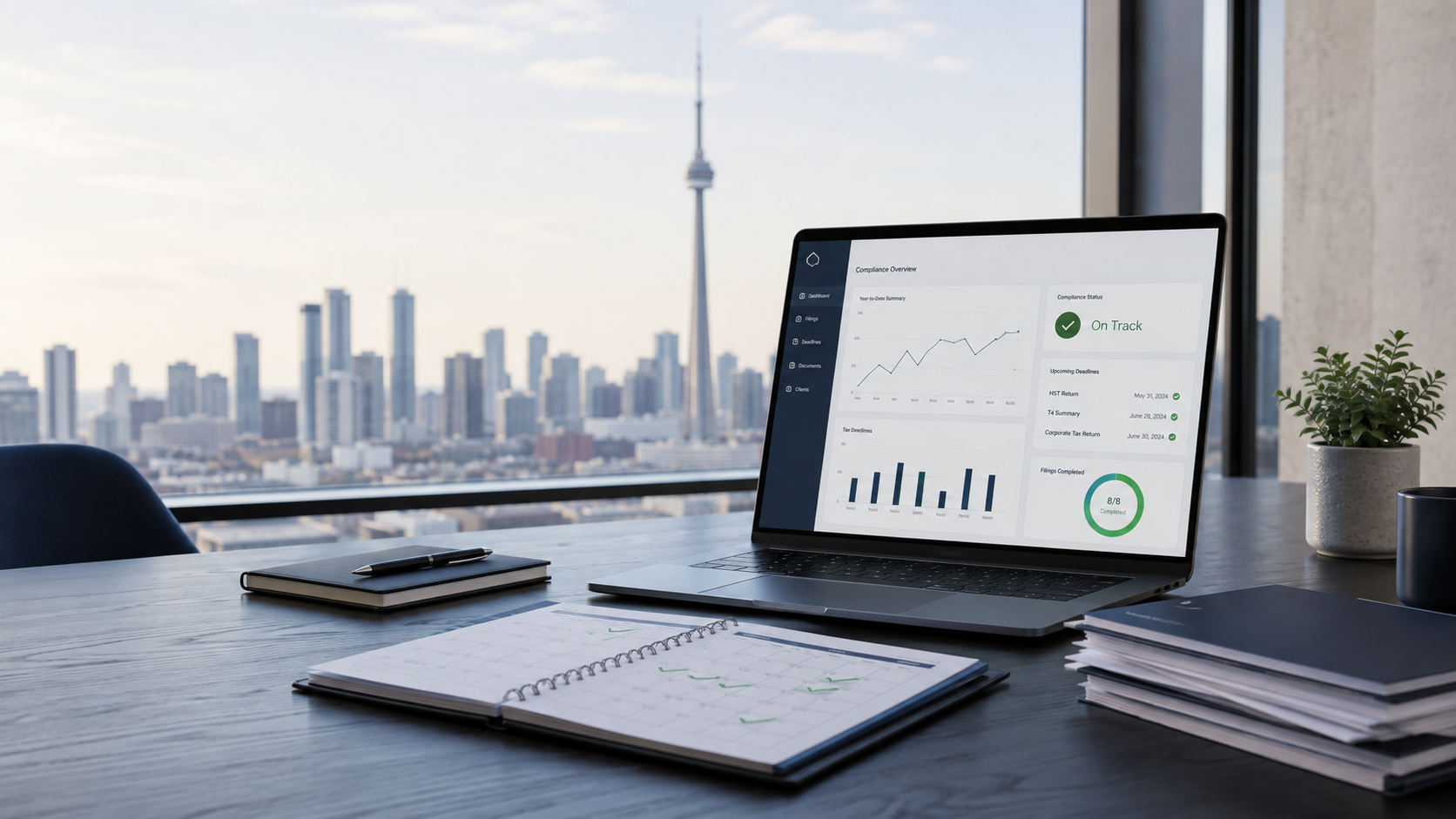
The better approach is proactive accounting management: keeping the books, reporting, tax obligations, and filing requirements under control throughout the year so that deadlines become routine rather than stressful.
For a growing business, that shift can make a significant difference. It reduces compliance risk, improves financial visibility, and gives the owner more time to focus on running the company.
Why Reactive Accounting Creates Unnecessary Stress
Most business owners are not trying to neglect their accounting. They are busy operating the business.
Customers come first. Staff issues come up. Sales need attention. Suppliers need to be paid. Accounting often gets pushed down the list until a deadline makes it impossible to ignore.
The problem is that deadline-driven accounting creates several risks.
First, it consumes time at exactly the wrong moment. Instead of focusing on revenue, operations, or strategy, the owner is collecting documents, answering bookkeeping questions, and trying to reconstruct transactions from months ago.
Second, rushed accounting increases the likelihood of errors. Missing receipts, duplicate transactions, incorrectly coded expenses, unreconciled accounts, or incomplete payroll information are much harder to fix when the filing deadline is days away.
Third, outdated books make it harder to make good business decisions. If the financial information is three or six months behind, the owner may not have a reliable view of cash flow, profitability, taxes owing, or upcoming obligations.
The greatest cost, however, is often the uncertainty.
Many owners spend the year wondering whether something has been missed.
That is what proactive accounting is designed to eliminate.
What Proactive Accounting Management Actually Means
Proactive accounting is not simply filing returns earlier.
It means creating a system where the major financial and compliance responsibilities of the business are monitored throughout the year.
For an Ontario small or medium-sized business, that may include:
- maintaining current cloud-based bookkeeping;
- reconciling bank and credit card accounts regularly;
- monitoring GST/HST filing requirements and remittance dates;
- keeping payroll records and source deduction obligations current;
- tracking WSIB and other employer-related requirements where applicable;
- preparing management reports throughout the year;
- identifying upcoming corporate and personal tax obligations;
- reviewing tax instalments and anticipated balances owing;
- maintaining organized supporting documentation;
- identifying available tax credits, deductions, and planning opportunities;
- preparing the year-end file before the corporate tax deadline is approaching.
Not every business requires the same schedule or level of support.
The important point is that the accounting process is planned in advance instead of being triggered by a CRA deadline.
The Accounting Cadence That Keeps a Business Organized
Strong accounting systems usually operate on a regular rhythm.
Throughout the month
Transactions are recorded, documents are collected, and bank and credit card activity is reviewed.
Questions are addressed while the information is still fresh instead of several months later.
This also makes it easier to identify unusual transactions, missing documentation, duplicate expenses, or cash flow issues early.
Monthly
The books should provide a reasonably current picture of the business.
Depending on the needs of the company, management reporting may include:
- revenue;
- gross margin;
- operating expenses;
- net income;
- accounts receivable;
- accounts payable;
- cash balances;
- payroll costs;
- tax liabilities;
- budget-to-actual results.
For a business owner, this information is often more valuable than the year-end tax return itself.
A tax return tells you what happened.
Good management reporting helps you decide what to do next.
Quarterly or according to the required filing schedule
GST/HST, payroll, instalments, and other compliance requirements should be monitored based on the filing frequency that applies to the business.
That frequency can vary.
For example, a GST/HST registrant may be an annual, quarterly, or monthly filer depending on its circumstances. Payroll remittance requirements can also vary by employer.
The objective is not to memorize every CRA deadline.
The objective is to have a system that tracks them before they become urgent.
Before year-end
Year-end tax planning should begin before the year is already over.
Depending on the business, this may involve reviewing:
- expected corporate income;
- shareholder compensation;
- salary versus dividends;
- capital asset purchases;
- tax instalments;
- outstanding receivables;
- accrued expenses;
- shareholder loan balances;
- available deductions and credits;
- corporate structure and longer-term planning opportunities.
Many tax planning opportunities are significantly easier to address before year-end than after it.
After year-end
When bookkeeping has been maintained properly throughout the year, the corporate year-end becomes much more efficient.
Instead of rebuilding twelve months of activity, the accountant is working from records that have already been maintained and reviewed.
That generally means fewer surprises, fewer questions, and a smoother corporate tax filing process.
Proactive Accounting Also Improves Decision-Making
Compliance is only one part of the benefit.
Current financial information allows an owner to understand what is actually happening inside the business.
A company can have strong sales and still experience cash flow problems.
Revenue can increase while margins deteriorate.
Payroll can grow faster than gross profit.
Accounts receivable can quietly become a major source of working capital pressure.
Those issues are difficult to identify when accounting is only reviewed at tax time.
With regular reporting, the conversation changes.
Instead of asking:
“How much tax do I owe?”
the owner can begin asking:
“Why did our gross margin decline?”
“Can we afford another employee?”
“How much cash should we keep in reserve?”
“Which service line is most profitable?”
“Are expenses growing faster than revenue?”
“What should we expect our tax liability to be?”
That is where accounting begins to function as a management tool rather than simply a compliance requirement.
Proactive Tax Planning Can Also Reduce Surprises
One of the most common frustrations business owners experience is receiving a large tax bill they were not expecting.
In many cases, the issue is not necessarily the amount of tax.
It is the lack of advance visibility.
If the books are reasonably current, the accountant can often estimate corporate taxes, GST/HST obligations, shareholder tax considerations, and instalment requirements before the payment date arrives.
That gives the business time to plan its cash flow.
It also creates opportunities to review whether legitimate tax planning strategies should be considered before year-end.
The goal is not aggressive tax avoidance.
The goal is to make informed decisions within the rules and avoid unnecessary surprises.
Where CRA Compliance Fits Into the System
The Canada Revenue Agency administers several filing and payment obligations that can apply to a business depending on its structure and activities.
These may include:
- corporate income tax returns;
- GST/HST returns;
- payroll source deductions;
- T4 and T4A information returns;
- tax instalments;
- shareholder reporting;
- partnership filings;
- trust filings;
- other industry-specific or transaction-specific reporting.
There may also be provincial requirements such as WSIB obligations depending on the business.
Missing a filing or payment deadline can result in penalties, interest, additional correspondence, or unnecessary administrative work.
A proactive system cannot guarantee that a business will never face a CRA inquiry.
What it can do is significantly improve the quality, organization, and timeliness of the records available when questions arise.
The Real Benefit: Accounting Stops Being an Emergency
The strongest accounting relationships are not built around one annual tax return.
They are built around continuity.
Your accountant understands the business.
The bookkeeping stays current.
Upcoming obligations are visible.
Tax planning happens before decisions become irreversible.
Management receives useful financial information.
Issues are addressed when they are still small.
That is what proactive accounting management is really about.
It does not eliminate every surprise that can happen in business.
It eliminates many of the preventable ones.
How MiAccounting Supports Ontario Business Owners
At MiAccounting, we work with owner-managed businesses that want more than a once-a-year tax filing relationship.
Our approach combines cloud accounting, bookkeeping, GST/HST support, payroll compliance, corporate tax preparation, management reporting, and year-round tax planning into a more consistent financial process.
The objective is simple: keep the accounting side of the business organized throughout the year so owners can make decisions with better information and fewer last-minute surprises.
If your current accounting process still revolves around catching up before every deadline, it may be time to change the cadence.
A proactive accounting system can help you stay ahead of CRA requirements, understand your numbers more clearly, and spend more of your time running the business instead of chasing the paperwork behind it.


