If you work as a subcontractor in Ontario, you are not just a skilled tradesperson. You are also running a business.
Whether you frame houses, pour concrete, install electrical systems, work in HVAC, roofing, flooring, drywall, plumbing, landscaping, or renovations, the money you earn can create tax and reporting obligations that employees rarely have to think about.
You may have to manage income tax, CPP, HST, WSIB, business expenses, tax instalments, and bookkeeping yourself. And in construction, there are additional reporting and worker-classification issues that can become expensive if they are handled incorrectly.
The good news is that none of this has to be overwhelming.
At MiAccounting, we work with subcontractors, tradespeople, contractors, and construction businesses across the Greater Toronto Area and Ontario. We help clients stay compliant, improve their bookkeeping, understand what they actually owe, and make better financial decisions as their businesses grow.
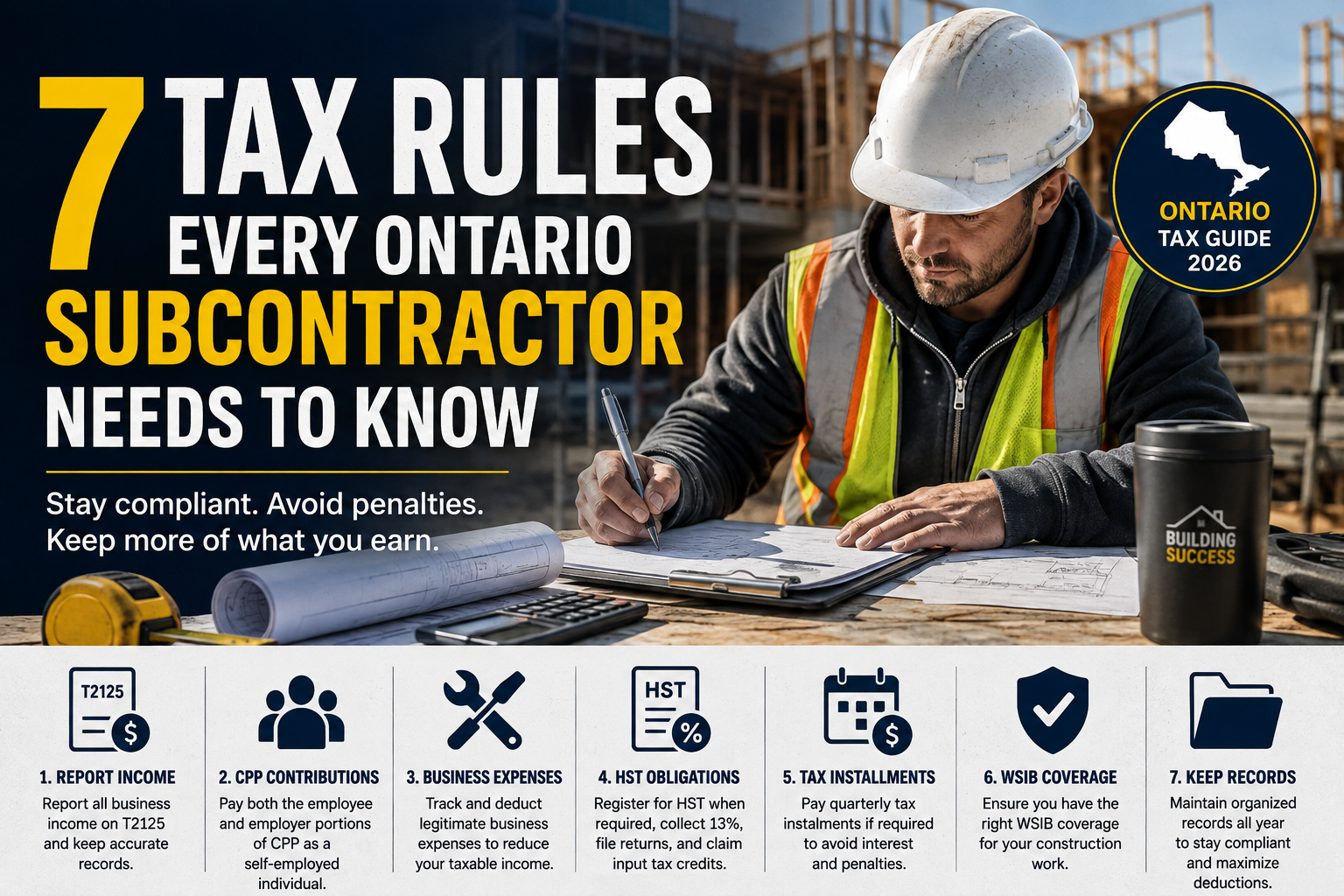
Here are seven tax obligations every Ontario subcontractor should understand.
1. Make Sure You Really Are a Subcontractor
Before worrying about deductions or HST, there is an important question to answer:
Are you actually self-employed?
Simply being called a “subcontractor,” submitting an invoice, or being paid without payroll deductions does not automatically make you self-employed.
The CRA looks at the actual working relationship.
Factors can include:
- How much control the contractor has over your work
- Who provides the tools and equipment
- Whether you can hire helpers or subcontract the work
- Whether you take on financial risk
- Whether you have an opportunity to earn a profit
- Whether you operate independently and work for multiple customers
- Whether you are responsible for your own business expenses
The CRA considers the entire relationship, not simply what the parties call it.
This distinction matters.
If you are truly self-employed, you are generally responsible for your own income tax, CPP, HST obligations, expenses, and business records.
If the relationship is actually an employer-employee relationship, different payroll rules can apply.
Getting worker classification wrong can create problems for both the worker and the business paying them.
2. Report All of Your Self-Employment Income
If you operate as a sole proprietor, your business income is generally reported on Form T2125, Statement of Business or Professional Activities, as part of your personal income tax return.
Unlike an employee who receives a T4 and has tax deducted from every paycheque, a subcontractor is generally responsible for tracking and reporting their own business income.
That includes payments received by:
- E-transfer
- Cheque
- Direct deposit
- Cash
- Credit card
- Other forms of payment
Construction is also an industry where the CRA has specific reporting requirements.
For example, businesses whose primary source of business income is construction may have to report payments made to Canadian-resident subcontractors using the T5018 Statement of Contract Payments system.
That means the CRA may already receive information showing how much certain contractors paid you.
Good bookkeeping therefore is not optional. Your reported income should reconcile to your invoices, bank deposits, HST filings, and other available records.
3. Understand CPP When You Are Self-Employed
CPP can be one of the biggest surprises for newly self-employed subcontractors.
When you are an employee, you pay part of your Canada Pension Plan contribution and your employer contributes an equal amount.
When you are self-employed, you generally pay both portions.
For 2026, the regular CPP contribution rate is 5.95% for the employee and 5.95% for the employer. A self-employed individual therefore effectively pays both sides, subject to the applicable CPP limits.
The maximum regular self-employed CPP contribution for 2026 is $8,460.90, and higher-income individuals may also be subject to additional CPP2 contributions.
This is one reason a subcontractor can earn what looks like a healthy profit and still receive a much larger tax bill than expected.
CPP should be included in your tax planning throughout the year rather than treated as an April surprise.
4. Track Your Business Expenses Properly
One of the advantages of being genuinely self-employed is that reasonable business expenses incurred to earn income may generally be deductible.
For subcontractors and tradespeople, common expenses can include:
- Tools
- Equipment
- Materials and supplies
- Vehicle expenses
- Fuel
- Commercial insurance
- Liability insurance
- Accounting and bookkeeping fees
- Cell phone costs
- Internet costs
- Software
- Advertising
- Bank charges
- Business licences
- Safety equipment
- Subcontractor costs
- Certain home-office expenses
But an expense being “for work” does not automatically mean the entire amount is deductible.
For example, if a truck is used partly for business and partly personally, only the appropriate business portion is generally deductible. Proper mileage records can therefore be extremely important.
Larger tools, vehicles, machinery, and equipment may also have to be capitalized and deducted over time rather than being written off entirely as a current expense.
The same principle applies throughout your books:
Good records create good deductions. Poor records create missed deductions, questionable claims, and unnecessary tax risk.
You should not be reconstructing a year of business activity from bank statements every April.
5. Know When You Must Register for HST
HST is one of the most common areas where subcontractors get into trouble.
In Ontario, the HST rate is 13%.
Generally, a business is considered a small supplier while worldwide taxable revenues remain at or below $30,000, subject to the CRA's small-supplier rules.
The threshold is not simply based on the calendar year.
You can lose small-supplier status if taxable revenues exceed $30,000:
- In a single calendar quarter, or
- Over four consecutive calendar quarters
The date on which you are required to register and begin charging HST depends on how the threshold is exceeded.
That timing matters.
If you were required to register but continued invoicing customers without HST, the CRA may still assess the HST that should have been collected.
You may then effectively have to pay the tax out of your own pocket.
Once registered, you generally charge HST on taxable services and remit the net amount to the CRA.
However, you may also be entitled to claim input tax credits, commonly called ITCs, for eligible HST paid on business expenses.
For example, HST paid on eligible:
- Tools
- Materials
- Fuel
- Equipment
- Professional fees
- Software
- Business supplies
may help reduce the HST you ultimately remit.
This is why proper bookkeeping and HST reporting should work together.
6. Prepare for Income Tax Instalments
Employees have income tax withheld from their pay throughout the year.
Subcontractors generally do not.
That means it is easy to look at money sitting in the business bank account and assume it is available to spend.
Some of it may belong to the CRA.
Depending on your tax situation, the CRA may require you to make quarterly income tax instalments.
For 2026, an individual generally has to make instalment payments if net tax owing is more than $3,000 for 2026 and was also more than $3,000 in either 2025 or 2024.
The regular instalment dates are:
- March 15
- June 15
- September 15
- December 15
Failing to make required instalments can result in instalment interest and, in some circumstances, penalties.
For many subcontractors, a useful habit is to transfer part of every customer payment into a separate savings account for taxes.
Some people use 25% to 30% of net income as a rough starting point, but the appropriate amount depends on your actual income, deductions, CPP obligations, other sources of income, and personal tax situation.
The better solution is to estimate your tax before year end rather than guess.
7. Understand Your WSIB Obligations
WSIB is particularly important in Ontario's construction industry.
Many independent operators, sole proprietors, partners, and corporate executive officers performing construction work can be subject to compulsory WSIB coverage.
An independent operator in construction who meets the applicable conditions may be required to register, report insurable earnings, and pay WSIB premiums even if they do not have employees.
There are exceptions.
For example, an exemption can apply to certain businesses doing only home renovation work on existing private residences where the contractor is hired and paid directly by the homeowner or resident.
However, the exemption has specific conditions, and businesses with employees may still have coverage obligations for those workers.
This is not an area where you want to assume the rules do not apply to you.
Before starting a major contract, working for a general contractor, or hiring workers of your own, make sure your WSIB position is clear.
Bonus: Your Bookkeeping Is the Foundation of Everything
Tax compliance is much easier when the bookkeeping is done properly throughout the year.
A clean set of books should allow you to quickly understand:
- How much you have invoiced
- How much customers still owe you
- What your actual expenses are
- How much HST you have collected
- How much HST you may be able to recover
- What your estimated profit is
- How much tax you should be setting aside
- Which customers and jobs are actually profitable
This becomes even more important as your business grows.
A subcontractor earning $80,000 a year has different planning needs than a contractor earning $300,000 or $500,000 and employing a crew.
Eventually, questions may arise about:
- Incorporating
- Paying salary versus dividends
- Hiring employees
- Buying vehicles or equipment
- Financing machinery
- Managing payroll
- WSIB
- HST filing frequency
- Cash flow
- Tax instalments
- Retirement planning
- Building retained earnings inside a corporation
At that point, accounting should not simply be something you do once a year to file a tax return.
It should help you run the business.
Should an Ontario Subcontractor Incorporate?
There is no single income level where every subcontractor should incorporate.
Incorporation can make sense in the right circumstances, particularly when the business is profitable and the owner does not need to withdraw all of the profits personally each year.
However, incorporation also brings additional costs and responsibilities, including:
- Corporate bookkeeping
- Corporate tax returns
- Payroll or dividend planning
- Separate bank accounts
- Corporate records
- HST administration
- Potential WSIB considerations
- Additional accounting costs
The decision should therefore be based on more than simply asking, “Will incorporation save me tax?”
The better question is:
Does incorporation fit how much I earn, how much I personally need to withdraw, my liability exposure, my growth plans, and what I want to do with the business over the next several years?
That is a planning conversation worth having before making the change.
The Biggest Mistake We See: Waiting Until Tax Season
Many subcontractors are excellent at their trade but treat the financial side of the business as an afterthought.
They invoice customers, pay bills, buy materials, use a truck for work, collect HST and keep moving to the next job.
Then tax season arrives.
Suddenly they are trying to figure out:
- Which deposits were income
- Which expenses were business-related
- Where the receipts went
- Whether HST was filed correctly
- Whether they should have registered earlier
- How much they owe in CPP
- Why their tax bill is so high
- Whether they can afford to pay it
By that point, many of the best planning opportunities are already gone.
Clean books throughout the year allow your accountant to advise you before decisions are made, not simply record what happened afterward.
Accounting Should Create Value, Not Just File Returns
When choosing an accountant, price matters, but it should not be the only consideration.
The cheapest accounting service is not necessarily the least expensive solution.
Poor bookkeeping, missed deductions, late HST filings, incorrect payroll, weak tax planning, or poor financial records can cost considerably more than the accounting fee itself.
Good accounting can help you:
- Avoid unnecessary penalties and interest
- Claim legitimate business deductions
- Understand your tax obligations before they are due
- Improve cash flow
- Price jobs more intelligently
- Understand your true profit margins
- Prepare for financing
- Make better equipment-purchase decisions
- Decide when incorporation makes sense
- Build a more valuable business
As a subcontractor becomes a larger contractor, the accounting work also becomes more sophisticated.
There may be payroll, subcontractor reporting, HST reconciliations, equipment depreciation, shareholder transactions, corporate tax planning, year-end adjusting entries, and financial reporting to manage.
That is why accounting fees often increase as businesses mature.
The work behind accurate financial statements is substantially greater for a growing construction company than it is for a new sole proprietor with a handful of transactions.
The goal should not simply be to find the lowest accounting fee.
Look for value.
A good accountant should save you time, reduce risk, help you understand your numbers, identify planning opportunities, and help you make better business decisions.
How MiAccounting Helps Ontario Subcontractors and Contractors
At MiAccounting, we work with subcontractors, tradespeople, contractors, and growing construction businesses across the Greater Toronto Area and Ontario.
Our services include:
- Bookkeeping
- Personal income tax
- Corporate income tax
- HST registration and filings
- Payroll
- WSIB support
- T5018 reporting
- Tax planning
- Cash-flow forecasting
- Incorporation planning
- Financial reporting
- Business planning
We do more than prepare a return after the year is over.
Our goal is to give business owners clean financial information throughout the year so they can make better decisions, stay ahead of their tax obligations, and build stronger businesses.
If you are an Ontario subcontractor and you are unsure whether your bookkeeping, HST, WSIB, tax instalments, or business structure are being handled properly, MiAccounting can help.
Stay compliant. Understand your numbers. Plan ahead. Build a better business.
.png)