
Accounting for Construction Businesses: Dos, Don’ts & Best Practices for Financial Success
Why Construction Accounting Is Different (And Easy to Get Wrong)
Running a construction or trade business means juggling moving parts every day—crews, suppliers, fluctuating material costs, subcontractors, weather delays, equipment rentals, progress draws, and retainage.
Construction is project-based, cost-sensitive, and cash-flow heavy, so generic accounting systems fail quickly.
The result?
- unclear job profitability
- underbilling or overbilling
- incorrect WIP
- compliance issues (CRA, WSIB, HST)
- unpredictable cash flow
To grow a construction company, you need an accounting system built for the industry.
DO: Track Job Costs for Every Project
Proper job costing is the foundation of profitability.
Track:
- labour
- materials
- subcontractors
- equipment
- overhead allocation
Without job costing, you’re flying blind.
DO: Maintain Clear WIP (Work-In-Progress) Reports
WIP reporting helps you understand:
- percentage complete
- earned revenue
- cost-to-complete
- underbilling or overbilling
- expected cash flow
Contractors who ignore WIP often have books that look profitable but bank accounts that disagree.
DO: Stay on Top of Payroll & Subcontractor Compliance
Construction payroll includes:
- overtime rules
- stats and vacation
- ROEs
- T4, T4A, and T5018 filings
- WSIB classification
- subcontractor documentation
- union vs non-union requirements
Misclassification can trigger penalties.
DO: Track HST, Equipment & CCA Properly
Construction businesses face complex tax situations.
Make sure you manage:
- input tax credits (ITCs) correctly
- progress draws and holdbacks
- equipment purchases
- capital cost allowance (CCA)
- financing vs buying strategy
These decisions have major tax and cash-flow consequences.
DO: Forecast Cash Flow Weekly
Because billing cycles can be irregular, contractors should revisit cash flow every week.
A good forecast includes:
- AP & AR
- payroll
- subcontractor payments
- equipment financing
- tax remittances
- expected draws
Cash flow—not profit—is what keeps the business alive.
DON’T: Mix All Job Costs Together
Never lump job costs into one expense line.
Each project needs its own:
- material tracking
- labour tracking
- subcontractor lines
- equipment allocation
This is the only way to know which jobs are profitable.
DON’T: Treat Subcontractors Like Regular Vendors
CRA requires construction-specific rules:
- subcontractor classification
- T4A or T5018 issuance
- WSIB coverage
- insurance documentation
Missing these = penalties.
DON’T: Ignore WIP or Retainage
Ignoring WIP leads to:
- misleading profit
- tax surprises
- cash-flow gaps
- bad project decisions
WIP is one of the most important tools in construction accounting.
DON’T: Wait Until Year-End to “Catch Up” on Books
Falling behind creates:
- inaccurate job costs
- missed ITCs
- HST penalties
- cash shortages
- CRA risk
Construction bookkeeping must be updated weekly or bi-weekly—not annually.
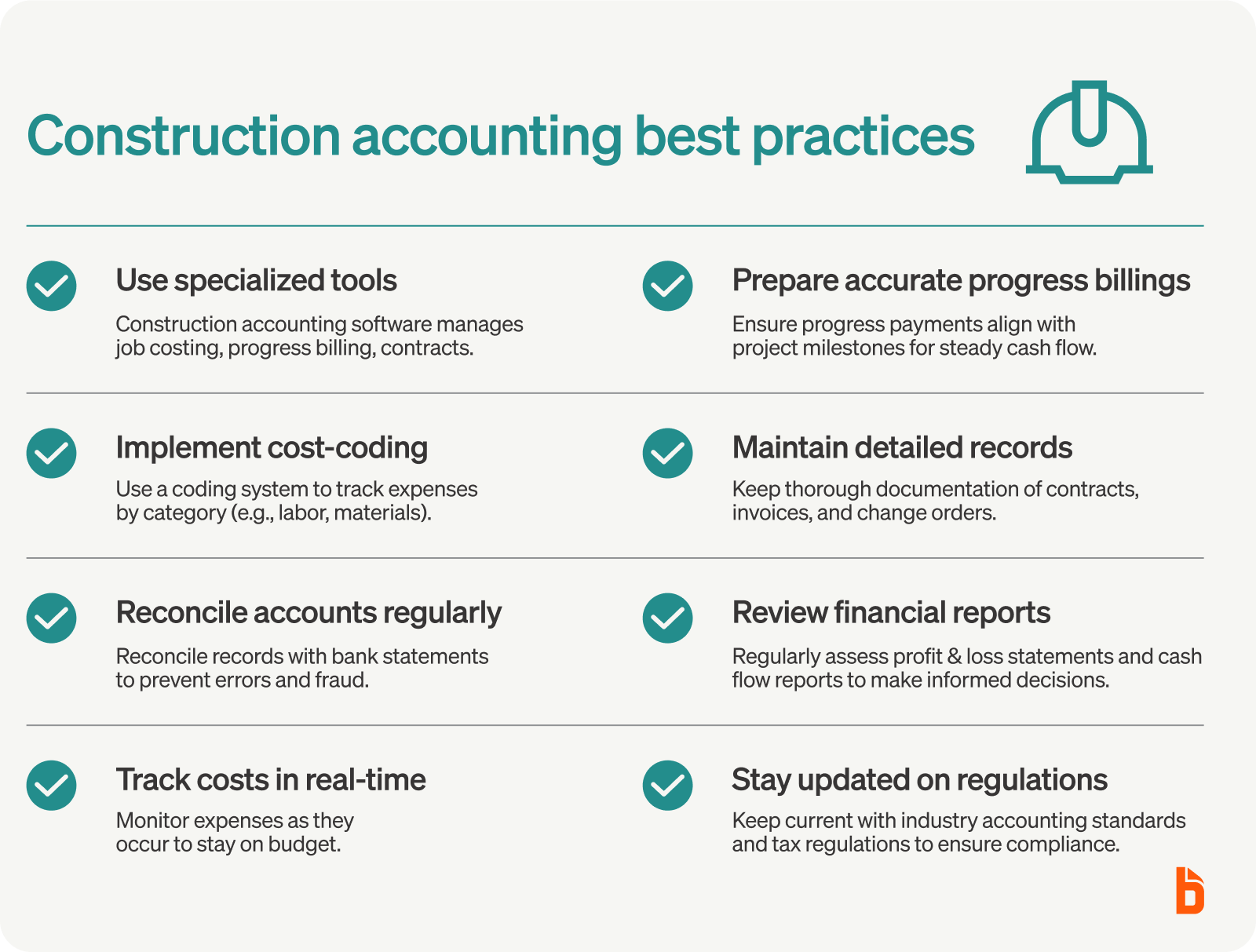
Best Practices for Building a Solid Construction Accounting System
A strong construction accounting system includes:
- job costing
- WIP updates
- payroll management
- subcontractor compliance
- accurate bookkeeping
- HST and tax strategy
- equipment & CCA tracking
- cash-flow forecasting
- OpCo / HoldCo structure planning
These components create clarity, stability, and profitability.
How MiAccounting Helps Contractors Win
At MiAccounting, we manage the entire financial back office for construction companies and trades across Ontario.
Our services include:
- job costing & project profitability tracking
- WIP reporting
- full payroll management
- ROEs, T4, T4A, T5018 filing
- subcontractor compliance tracking
- bookkeeping, AP/AR
- HST filing & corporate tax
- equipment planning & CCA
- OpCo/HoldCo structuring guidance
- cash-flow forecasting
- CRA and WSIB support
👉 Learn more about our Construction Accounting Services
https://www.miaccounting.ca/industries/construction-accounting-services-for-construction-companies
Final Thoughts
Construction accounting is unlike any other industry. When done right, it gives you:
- clarity on every job
- better cash flow
- fewer surprises
- stronger bids
- profitable growth
- peace of mind
If you want a partner who understands both accounting and the trades, MiAccounting is here to help.
Book a Construction Accounting Consultation
We’ll review your current setup, identify gaps, and build a system that works for the way your business really runs.
👉 https://www.miaccounting.ca/industries/construction-accounting-services-for-construction-companies