How CRA Really Treats Business Gifts in Canada
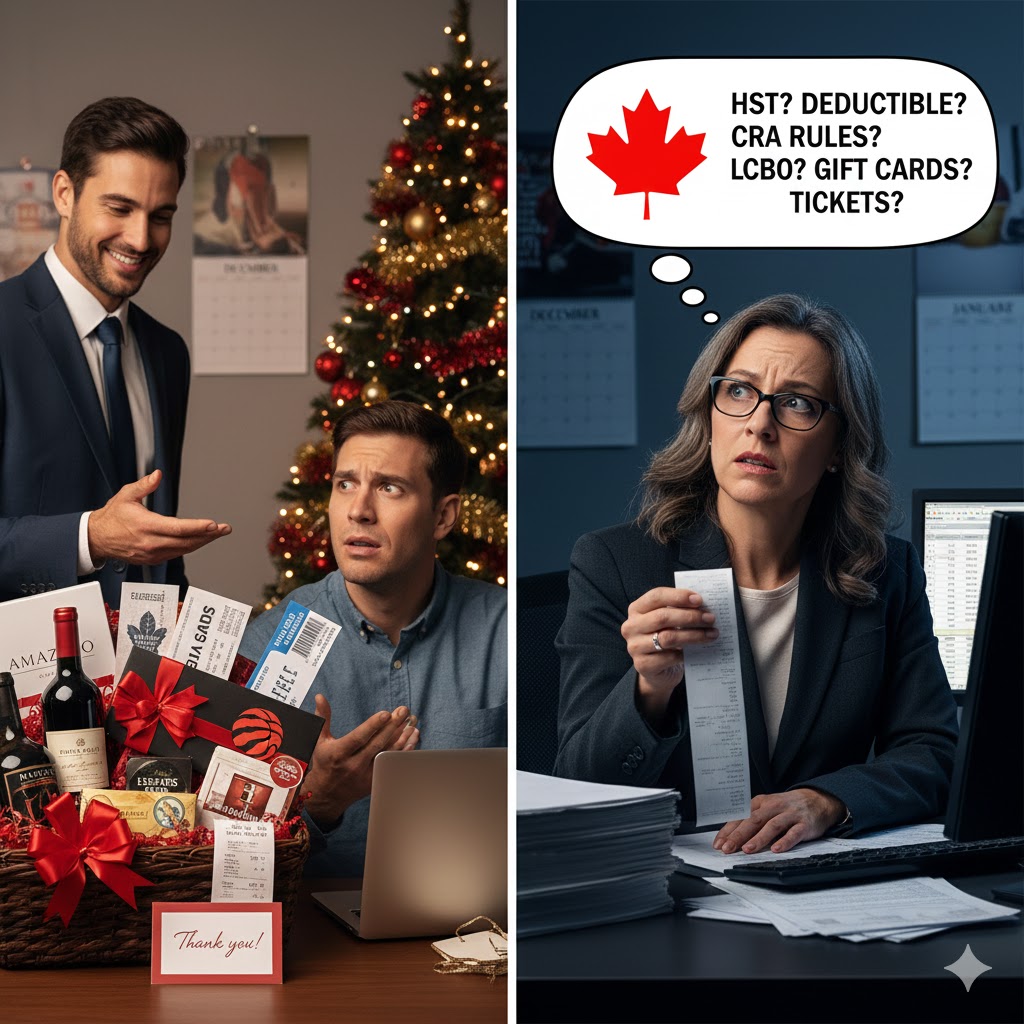
December is generous.
Clients are thanked. Referral partners are appreciated. Relationships are nurtured. Bottles of wine are picked up at the LCBO. Gift cards are sent. Chocolates, holiday baskets, and event tickets land on desks and in inboxes.
Then January arrives.
January is when your accountant opens your books, reconciles December, and starts asking questions.
Why are there LCBO receipts?
Who were the gift cards for?
Are these Raptors or Leafs tickets gifts… or entertainment?
Can the HST be claimed? Are these deductible?
This is where good intentions meet CRA rules — and where many business owners (and even some bookkeepers) unknowingly get it wrong.
Let’s break down exactly how CRA treats business gifts in Canada, using the Income Tax Act, the Excise Tax Act, and real-world accounting practice.
What Is Considered a Business Gift?
A business gift is an item given to a non-employee (such as a client, supplier, or referral partner) primarily for business purposes, including:
- Client appreciation
- Relationship building
- Business development
- Maintaining goodwill
Common real-world examples we see in bookkeeping files:
- Wine or spirits (LCBO purchases)
- Gift cards (Amazon, restaurants, coffee shops)
- Holiday baskets or chocolates
- Thank-you gifts for referrals
- Seasonal client appreciation items
Business gifts are not the same as:
- Meals and entertainment
- Employee gifts and awards
- Advertising items distributed broadly
Each category has different tax rules, and misclassification is one of the most common CRA issues we see.
Income Tax Treatment of Business Gifts
(Income Tax Act)
The Core Legal Rules
Under the Income Tax Act, business gifts fall under the general deductibility rules:
- ITA s.18(1)(a)
Expenses must be incurred for the purpose of earning income from a business or property. - ITA s.67
Expenses must be reasonable in the circumstances.
There is no specific dollar cap in the Income Tax Act for business gifts.
CRA does not look for a preset limit. Instead, they assess:
- The business purpose of the gift
- The relationship to the recipient
- Whether the amount is reasonable in context
A modest client appreciation gift is generally acceptable. A lavish or highly personal item may be challenged or partially denied.
Business Gifts vs. Meals & Entertainment
(Where Most Mistakes Happen)
Business gifts are often incorrectly lumped in with meals and entertainment. This is a costly mistake.
- Meals and entertainment are subject to the 50% deductibility rule under ITA s.67.1
- Business gifts are not automatically subject to this rule
Practical examples:
- Bottle of wine or gift basket → Business gift
- Taking a client to dinner → Meal & entertainment
- Raptors or Leafs tickets → Entertainment (50% rule applies)
Even if event tickets are gifted and you do not attend, CRA generally treats tickets as entertainment, not a business gift.
CRA looks at the nature of the expense, not your intention.
GST/HST Treatment of Business Gifts
(Excise Tax Act)
Income tax deductibility and HST recovery are two separate analyses.
General ITC Rule
Under the Excise Tax Act, GST/HST registrants may claim input tax credits (ITCs) for tax paid on expenses used in commercial activities.
However, CRA applies a specific limitation to ITCs for business gifts and promotional items.
ITC Limitation on Business Gifts
CRA’s administrative position limits ITCs to the GST/HST paid on the first $50 (before tax) per recipient per year for business gifts.
- ITCs are claimable on the first $50
- GST/HST on amounts above $50 is not recoverable
- This applies even if the gift is deductible for income tax purposes
This is one of the most common adjustments we see during CRA reviews.
How to Categorize Business Gifts Properly
(This Is Critical)
Correct categorization keeps your books clean and your tax filings defensible.
1️⃣ Business Gifts / Client Appreciation
Examples:
LCBO purchases, gift cards, gift baskets, chocolates, physical thank-you gifts
GL account:
Business Gifts / Client Appreciation
(or a sub-account under Marketing or G&A)
Tax treatment:
- Generally deductible (subject to reasonableness)
- HST ITCs limited (handled at tax time)
2️⃣ Meals & Entertainment
Examples:
Client dinners, drinks, sporting or concert tickets (including gifted tickets)
GL account:
Meals & Entertainment
Tax treatment:
- 50% deductible for income tax
- HST recovery restricted
3️⃣ Advertising & Promotional Items
Examples:
Branded pens, mugs, calendars, trade-show giveaways, swag distributed broadly
GL account:
Advertising & Promotion
Tax treatment:
- Fully deductible
- Full HST ITCs generally available
4️⃣ Employee Gifts (Separate Rules)
Employee gifts follow taxable benefit rules and should never be mixed with client gifts.
Best Practices to Stay CRA-Compliant
To protect yourself in a CRA review:
- Keep original receipts
- Record the recipient’s name
- Document the business purpose
- Categorize based on what the expense actually is
Good documentation turns a CRA question into a non-issue.
Frequently Asked Questions: Business Gifts & CRA Rules (Canada)
Are business gifts tax deductible in Canada?
Yes. Business gifts to clients, suppliers, and referral partners are generally deductible if incurred to earn business income and reasonable in the circumstances, as required under sections 18(1)(a) and 67 of the Income Tax Act.
Is there a dollar limit on deducting business gifts?
No. The Income Tax Act does not impose a specific dollar limit. CRA evaluates reasonableness, business purpose, and context rather than a fixed cap.
Are business gifts subject to the 50% meals and entertainment rule?
No. The 50% limitation under section 67.1 applies only to meals and entertainment, not to non-entertainment business gifts.
Are Raptors or Maple Leafs tickets considered gifts or entertainment?
They are generally considered entertainment by CRA and are subject to the 50% limitation, even if the tickets are gifted and the business owner does not attend.
Can I claim GST or HST on business gifts?
GST/HST input tax credits are limited. CRA allows ITCs on the GST/HST paid on the first $50 (before tax) per recipient per year. GST/HST paid above that amount is not recoverable.
Is HST treatment different from income tax treatment?
Yes. Income tax deductibility and GST/HST recovery are separate analyses. A gift may be deductible for income tax purposes but still have limited or denied HST ITCs.
How should business gifts be categorized in bookkeeping?
They should be recorded in a separate “Business Gifts” or “Client Appreciation” account, not under meals and entertainment or employee benefits.
Are gift cards deductible as business expenses?
Yes, if given to clients or business contacts for business purposes and properly documented. They are generally treated as business gifts.
What documentation does CRA expect?
Receipts, recipient identification, and a clear business purpose. Poor documentation is one of the most common reasons deductions are denied.
Final Thought
December is the season of giving.
January is when your accountant makes sure it was done correctly.
Getting this right isn’t about being aggressive or conservative — it’s about being accurate.
If your books include client gifts, gift cards, or event tickets, it’s worth making sure they’re categorized and treated properly before CRA does it for you.
Need Help Cleaning Up Your Books or Year-End?
At MiAccounting, we help Canadian business owners:
- Categorize expenses correctly
- Stay CRA-compliant
- Avoid unnecessary reassessments
- Keep their books clean, defensible, and audit-ready
If you have questions about business gifts, HST, or expense deductibility, we’re happy to help.